Cheeky Mouse Redux

Cheeky Mouse (Universal Games, 1980) is a very simple game, but an excellent example of classic arcade style. In Cheeky Mouse, you play as a man with a hammer, and your only goal is to kill mice before they steal your 8 pieces of cheese.

Richard Rouse, in his article “Centipede”, identified classic arcade games as taking place on a single screen, and being short, replayable, and easy to understand. They employ simple game play, and feature infinite play with multiple lives and a scoring system. Cheeky Mouse checks all these boxes, making this simple game about whacking mice a good example of the genre.


Cheeky Mouse takes place on a single screen, with the player confined to one horizontal row.

Game play occurs on a single screen. A thin line on the bottom third of the screen serves both as the floor you walk on and the barrier the mice must chew through in order to steal your cheese. One whack will suffice to eliminate a mouse, but over time the waves grow in number, and the tension rises as eight mice carry out a synchronized attack on your cheese stash. Mice spawn from the top of the screen, and take random, curving paths down to the floor. The player can only attack mice who are actively chewing through the floor or while they are coming back up from under the floor to return the cheese. This creates a sense of urgency, because once the mice pass the player’s area, they must watch them scurry away with their cheese, forced to witness but unable to stop the theft. Additionally, some levels have windows in the center of the screen, which block the mice from sight as they change trajectory, so the player won’t know where the mouse will emerge from. As Rouse mentions, this single screen allows the player “to see the entire game-world, and make his decisions with full knowledge of the state of that game- world” (462).


This diagram from the Cheeky Mouse User’s Manual shows that the cabinet had one horizontal joystick and one button for play.

Cheeky Mouse has only 3 buttons: left, right, and whack. This makes the game very easy to learn, but mastering it is tricky. Players must learn to prioritize which mice to hit first, as speed limitations of the player character sometimes make it impossible to eliminate all mice before they chew through the floor. If a mouse does make it through, the player can retrieve their stolen cheese by whacking the mouse as it crawls back out. But the player must be careful not to let too many mice through, as it takes several seconds for a mouse to chew down through the floor, but they crawl back out much faster.

Each coin gives the player 3 lives, and if they die (by having all their cheese stolen) then they can resume at the same place in the wave for that level, but with all 8 pieces of cheese back. This way, the player doesn’t lose all their progress and feels motivated to continue playing. As the threat of mice is unending, this game could be played infinitely, with the mice increasing in speed and number as the player advances through each level.

Rouse, Richard. “Centipede.” Game Design: Theory & Practice. 2nd Edition. Wordware Publishing, 2004.

Interactive Storytelling in Gone Home

In Gone Home, you play as Katie (that’s me!), who has just returned home from a trip across Europe. The game opens with a voicemail from Katie to her mom explaining that her flight home will be arriving late at night and that she will take a shuttle home. The first space you see if the entryway to the family home. There’s a note on the door from Katie’s sister Sam, explaining that she’s gone and asking Katie not to look for her.

Why am I locked out of rooms in my own home? Who locked this? What’s behind here?

In their chapter on Narrative, Egenfeldt-Nielsen et Al assert that “the most important component of a game world is the game space, understood as the setting for the gameplay. Game spaces are not realistic, but reductive; they reproduce some features of the real world, but create their own rules in order to facilitate gameplay” (175). The first few moments of Gone Home clearly establish the game space as existing somewhere in the real world (in Portland, if you look at the tag on Katie’s backpack). The game takes place in Katie’s home, and the player must investigate the rooms of the house in order to figure out what happened to her family. However, some rooms are locked. This steers the narrative by making players explore certain parts of the house before others, that way the story can be presented in order. Additionally, some lights and televisions are on in the home, even though no one is there. Locked doors and switched on lamps aren’t something you would expect to find in your own empty home, but they shape the game space and narrative.

Foyer in Gone Home
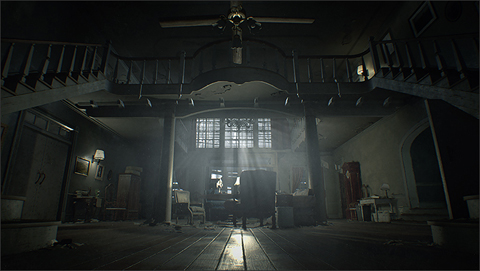
Foyer in Resident Evil 7, a popular horror game.

Gone Home plays with the idea of a literary repertoire, “the familiar territory within the text” (184), in interesting ways. Egenfeldt-Nielsen et Al expand on Wolfgang Iser’s definition, by saying “The repertoire is activated by ‘clues’ in the game” (185). My roommate once described Gone Home as “the scariest non-horror game” (Neuharth, 2019). Gone Home takes place during a thunderstorm. Lightning flashes periodically and rain is the only background noise for most of the gameplay. The house is old, it creaks and the lights flicker, and it is described in one of your sister’s journals as “the Psycho House.” Using one’s literary repertoire, the player may be inclined to think Gone Home is a horror game. Certainly, the environment produces a sense of unease as the player explores this old, empty house. However, there are no enemies in Gone Home, and no way to die.

Throughout Gone Home, the player must pick up journal entries and piece together the reasons for Sam’s disappearance. By manipulating the game space, Gone Home ensures that the player will find these clues in a linear fashion, which creates a cohesive narrative. Additionally, using clues that align more closely with horror games gives Gone Home a more tense atmosphere than it would if the game took place at noon on a sunny day. This tension provides a useful backdrop for Gone Home’s main story about Sam falling in love and running away- making hard decisions in pursuit of her own happiness. This transitory stage of Sam’s life is told only through journal entries, but by making the house feel scary and unsafe, the player can more closely identify with Sam’s narrative and motivations.

Egenfeldt-Nielson, Simon et Al. “Narrative.” Understanding Video Games: The Essential Introduction. Routledge. 2007.

Game Aesthetics in Journey

In his article on game aesthetics, Simon Niedenthal states that “digital games exist in the realm of art and aesthetic experience,” (Niedenthal, 1). Journey provides an excellent example of this point. The game play in Journey is very simple- you can walk, float (using power stored in your scarf), and make a chirping noise to communicate with the fabric beings that populate the world. With only three actions available to the player, they are able to focus more attention on the way the game looks, sounds, and feels. This works to place emphasis on game aesthetics, identified in Niedenthal’s first definition as “the sensory phenomena that the player encounters in the game,” (Niedenthal, 2).

In the first few moments of Journey, players are clued in on where to go by this fabric moving, the only landmark in what appears to be endless sand.

Journey relies heavily on visual markers to help you navigate the game world and orient you on the path forward. In several levels, players can actually see the mountain they are supposed to climb, and are able to walk toward it. When the mountain is not visible, players can still stay on the right path by following the trail of fabric beings on the ground, or broken metal constructs which function as a sort of bread crumb trail highlighting the path through the game. This emphasis and reliance on visual cues also encourages the player to take in the details of their environment.

Sound also plays in integral role in Journey. Karen Collins identified some of the roles of game sound as providing “links or bridges between two scenes, or which indicate the opening or ending of a particular part of gameplay, ” (Collins, 131). Journey contains several different environments, each with their own score that seems to almost complete the area. The rolling dunes at the beginning of the game are set to calm, gentle music, while later levels, such as the one where you slide down sand through a buried city, have a more fast paced and exciting track to go along with them. This function of sound can be seen very drastically in the areas that contain metal dragon-like creatures, which will pull off part of your scarf if they spot you. When these creatures are around, the music becomes more frenetic and frenzied, adding a level of anxiety to the sound that matches the visual of these huge, dangerous constructs floating through the sky. Collins also says that “a drop to silence can… tell the player that they should have completed that segment of the game,” (Collins, 131). In Journey, when you complete a level, the sound will “drop to silence” until you move on to the next area.

These machines make high pitches screeches that contrast with the smooth sounds of the game. This contrast encourages the player to avoid them, as they sound very different from the game so far.

The different aspects of game aesthetics Journey employs work together to create a narrative that players understand. There are no words in this game, but the changing environments give the player the sense that they are progressing and moving up the mountain. The music that plays when the constructs are floating overhead, and the screeching sound they make, let the player know that they are dangerous and should be avoided.

Papers, Please

Johan Huizinga opens his essay Nature and Significance of Play as a Cultural Phenomenon by saying “[Play] is a significant function… there is some sense to it,” (Huizinga, 97). In saying this, he is establishing that play is not purely instinctive, nor is it an activity of paramount biological import. This principle can be seen throughout the game Papers, Please, which is an exhaustingly mindless simulator in which you play as an immigration inspector in the fictional country of Arstotzka. Each day in-game, you must check passports and ID cards and work passes and ensure that everything across all the documents matches up correctly. Additionally, each night you must balance your expenses and make sure you budget enough for your family to survive. This game is clearly not instinctive- we need some higher order drive in order to want to play it, but there is also something cathartic about going to your fictional job and taking care of your digital family. Mistakes have consequences (your pay could get docked, your family members may go hungry), but you are allowed to make mistakes here- it’s only a game. Additionally, as the pile of documents you must sift through adds up, each discrepancy you find or valid passport you accept comes with a rush of accomplishment.

The volume of documents to examine can be overwhelming, but doing your job well leads to a tremendous sense of accomplishment.

            Later in his essay, Huizinga defines play as “the direct opposite of seriousness,” (Huizinga, 101). At first glance, this definition may seem incongruous with Papers, Please as your digital son is cold, sick, and hungry, and you witness a series of terrorist attacks from your desk. But these events are actually “the direct opposite of seriousness,” as you are able to see them from the safety of your computer screen instead of being forced to confront them in your day-to-day life.

            Huizinga also identifies an important aspect of play as “its limitedness,” or the fact that periods of play have a definite end. At any time, the player can exit Papers, Please and go back to their regular obligations. The game saves at the beginning of each day and, as each day is relatively short, there is no real consequence to ending the game at any time. If any progress is lost, it won’t be much. Papers, Please provides you with temporary escapism, and you get to decide when it’s over.

Huizinga, Johan. “Nature and Significance of Play as a Cultural Phenomenon.” The Game Design Reader: a Rules of Play Anthology, by Katie Salen and Eric Zimmerman, MIT Press, 2009, pp. 96–120.

Cheeky Mouse

Cheeky Mouse takes place on a single screen, with the player confined to one horizontal row.

Cheeky Mouse, published by Universal Games in 1980, is a very simple game, but an excellent example of classic arcade style.  In Cheeky Mouse, you play as a man with a hammer, and your only goal is to kill the mice before they take all 8 of your pieces of cheese. A thin line on the bottom third of the screen serves both as the floor you walk on and the barrier the mice must chew through in order to steal your cheese. One whack will suffice to eliminate a mouse, but over time the waves grow in number, and the tension rises as eight mice carry out a synchronized attack on your cheese stash. Mice spawn from the top of the screen, and take random, curving paths down to the floor. The player is confined to a single horizontal row on the screen, while the mice are free to crawl about. This way, the player can only attack mice who are actively chewing through the floor or while they are coming back up from under the floor to return the cheese. This creates a sense of urgency, because once the mice pass the player’s area, they must watch them scurry away with their cheese, forced to witness but unable to stop the theft. Additionally, some levels have windows in the center of the screen, which block the mice from sight as they change trajectory, so the player won’t know where the mouse will emerge from.

This diagram from the Cheeky Mouse User’s Manual shows that the cabinet had one horizontal joystick and one button for play.

Cheeky Mouse has only 3 buttons: left, right, and whack. This makes the game very easy to learn, but mastering it is tricky. Players must learn to prioritize which mice to hit first, as speed limitations of the player character sometimes make it impossible to eliminate all mice before they chew through the floor. If a mouse does make it through, the player can retrieve their stolen cheese by whacking the mouse as it crawls back out. But the player must be careful not to let too many mice through, as it takes several seconds for a mouse to chew down through the floor, but they are only within whacking range for a split second as they crawl back out.

Each coin gives the player 3 lives, and if they die (by having all their cheese stolen) then they resume at the same place in the wave for that level, but with all 8 pieces of cheese back. This way, the player doesn’t lose all their progress and feels motivated to continue playing. As the threat of mice is unending, this game could be played infinitely, with the mice increasing in speed and number as the player advances through each level. In Richard Rouse’s article Centipede, he identified classic arcade games as being short, replayable, and easy to understand. Additionally, they use a single screen, employ simple gameplay, and feature infinite play with multiple lives and a scoring system. Cheeky Mouse checks all these boxes, making this simple game about whacking mice a good example of the genre.